


How to Create a Living Statue Scare for Your Haunted House
A living statue scare begins with a believable mistake: guests think a costumed performer is another figure in the display. The reveal arrives when that apparently fixed object looks back at them. It can be a strong addition to an October haunt because the idea is easy to understand and does not depend on a long script.
The work happens before the movement. Costume, pose, lighting, and placement must tell the same story. This guide uses a decayed cemetery guardian as an example, with the actor standing beside the route in a dedicated performance space.
Choose a figure that belongs in the display
A guardian among grave markers has a reason to stand still. So does a museum exhibit, a forgotten portrait subject, or a figure in a haunted manor's collection. Choose the character before choosing the final pose, then surround it with a few scenic details that explain its presence.
For a cemetery scene, a plaque and a stone-like base facade can suggest a memorial figure. The actor should stand on a stable surface suited to the performance; a decorative pedestal appearance does not require the performer to balance on a narrow raised platform.
Keep the fiction simple. A plaque reading “Keeper of the Grounds” gives guests enough information to interpret the figure. Several paragraphs of invented history may slow the group without improving the reveal.
Build a decayed guardian with Father
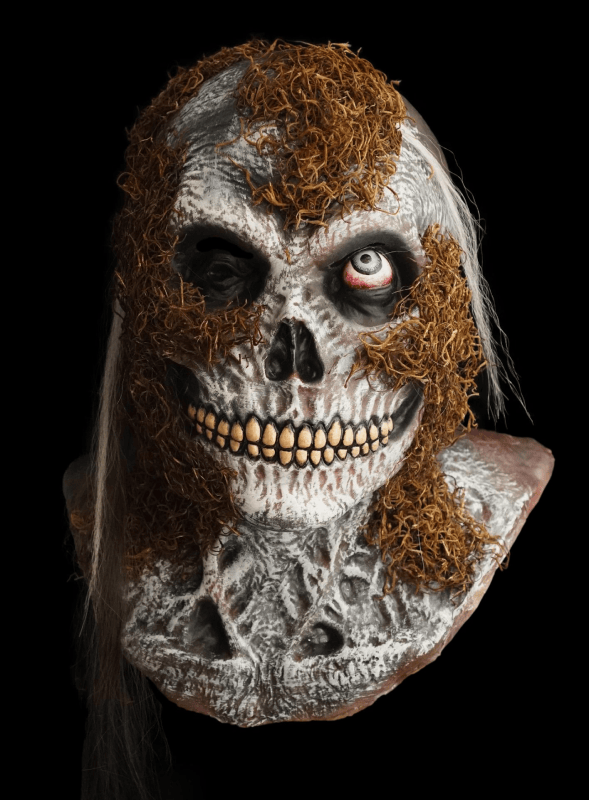
The Father HD Studios Pro Halloween Mask has a decayed skull-like face, long gray-white hair, dried brown moss, and an extended neck and chest bib. Its uneven eyes—one pale, one hollow-looking—can support an unsettling guardian character.
This is an overhead latex mask, not a complete statue costume. Pair it with separately selected clothing and hand coverage that suit the character. A long, weathered-looking garment can connect the head to the body, while the extended bib helps you plan the neckline.
The mask already has detailed coloration and texture. You can create a believable figure through costume and setting without coating the mask in additional scenic paint. Follow the product's care instructions for handling and cleaning.
Let visitors see the figure before it moves
Place the actor where an approaching group can notice the whole silhouette. If the figure is entirely hidden until it lunges out, the scene becomes a different kind of scare. For this effect, guests need a moment to classify the performer as part of the scenery.
Try a grave marker in the foreground, the guardian behind and to one side, and a dark scenic panel farther back. Keep a clear gap between the guest route and the actor's working area. The arrangement should invite a look without requiring visitors to approach or touch the figure.
Test the view from the front and rear of a practice group. If only the first person can see the face, turn the figure slightly or change the foreground decoration. A small adjustment in placement may do more than adding another prop.
Pick a pose the performer can comfortably repeat
Start with a natural, balanced stance and hands resting in a position the actor can sustain for the rehearsed interval. Avoid a pose that depends on locked knees, a heavy raised prop, or long periods without a break. Build relief and rotation into your operating plan.
Practice in the complete costume. Hair, sleeves, and loose accessories may move when the performer resets or turns their head. Decide which movements suit the character and which distract from it. The goal is a convincing starting image, not a demand for absolute stillness at any cost.
Give the actor a clear way to signal the crew if visibility, costume fit, or fatigue makes the scene unsuitable to continue. A performer should be able to step out and reset the situation.
Use one unmistakable change
A slow head turn can be enough. Another option is to shift the gaze toward the group and lift one hand within the performance area. Test a small movement first, then add only what the scene needs. Reaching into the walkway or pursuing guests is unnecessary for this concept.
Here is a complete sequence: the group sees the keeper, the front visitor reaches the plaque, the keeper turns toward them, and the performer holds the new pose as the group continues. The actor returns to the starting position only when the route is clear and the next group is not watching.
If guests recognize the actor early, stay in character. A measured look can still finish the encounter. There is no need to escalate the movement to prove that the performer surprised someone.
Make the lighting support the illusion
Keep enough light on the figure for guests to notice the face and costume. Use the background to separate the silhouette, and check whether the light changes dramatically when the actor turns. A face that is visible in the starting pose may fall into shadow during the reveal.
Run the effect under the lighting you will actually use, with adjacent scenes operating. Nearby moving lights or bright effects can draw attention away at the critical moment. Adjust the cue or placement while keeping the guest route readable.
Rehearse the return and the handoff
Use a crew cue to confirm when the next group may approach. Give the actor enough time to return, settle the costume, and check the space. If the group spacing changes, shorten the performance or pause the scene instead of rushing into position in full view.
For more preparation, read our scare actor guide. To compare Father with other character options, explore the 2026 HD Studios Pro Mask Collection. A clear character and one controlled movement give this scene its identity.


Leave a comment