


Haunted House Scare Timing: How to Reset Between Groups
A scare can look excellent in rehearsal and still unravel once several groups arrive close together. One group pauses at the exit, the next sees the actor walking back, and the sound effect begins before the performer is ready. The problem is often the reset.
Plan the full cycle: ready, approach, reveal, release, and return. Each stage needs a clear cue and enough room to happen. During the final weeks of October, this approach helps a team keep the scene understandable as visitor pace changes.
Define what “ready” looks like
Before a group enters, the actor should be in the starting position, the route should be clear, and any sound or lighting controls should be ready. A movable scenic piece must also be back where it belongs. If one of those conditions is missing, the scene is not ready simply because another group is waiting.
Choose a short signal between the performer and the person managing entry. It could be a visible crew gesture or a communication method already used by your attraction. Make sure everyone understands both the ready signal and the signal to pause. Do not rely on a guess from another room.
Use a guest position as the action cue
“Wait a few seconds” is difficult to repeat when groups walk at different speeds. A visible position is more useful: the front visitor reaches a sign, the middle of the group passes a scenic window, or the final visitor clears a doorway.
Select the cue for your particular sightline. A reveal aimed only at the first person can be invisible to those behind. Walk the route with a practice group and check who can see the character at the moment of movement. Adjust the actor's angle or the cue location before changing the performance.
Example: a zombie at the quarantine window
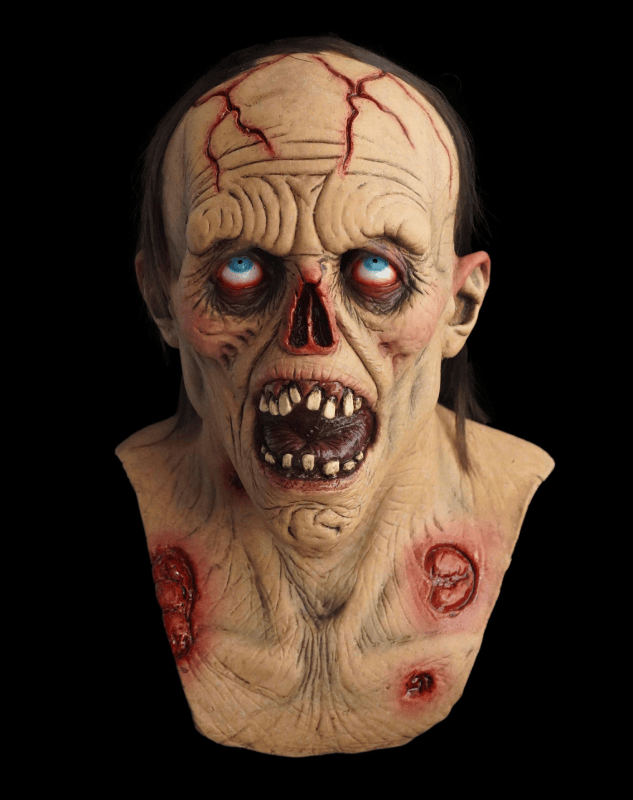
The Screamer Zombie HD Studios Pro Halloween Mask has an overhead latex design with a sculpted open-mouth scream, sunken cheeks, exposed-bone details, and a hand-painted finish. The mouth is part of the sculpt; plan the performance around head and body movement rather than assuming it is a moving-mouth effect.
For this scene, the actor waits behind an open scenic window beside the guest route. A quarantine notice draws attention toward the opening. When the group reaches the agreed cue, the zombie turns into view and holds a clear pose inside the performance area. Guests continue onward while the actor remains in character.
Once the group has cleared the sightline, the performer returns and signals ready. Clothing, hand coverage, window scenery, and sound equipment are separate elements of the concept. Check that the opening gives the costumed performer adequate clearance for the rehearsed movement.
Write the whole sequence on one card
| Stage | Observable cue | Crew action |
|---|---|---|
| Ready | Actor set; path clear | Confirm the scene can receive a group |
| Approach | Visitors reach the agreed marker | Prepare the reveal cue |
| Reveal | Character visible to the intended group | Complete one rehearsed movement |
| Release | Group continues toward the exit | Allow passage and stay in character |
| Return | Previous group has cleared the sightline | Reset and confirm ready again |
This card is also useful when a relief performer takes over. Include the starting pose, the cue, and the boundary of the performance area. Avoid vague instructions such as “go harder when it gets busy.” Busy periods call for clear coordination.
Measure the scene you actually have
During rehearsal, time a complete cycle from ready to ready. Repeat it with a group that moves quickly, a group that pauses, and a group that needs more time to pass. The useful result is an observed range for your scene, not a universal number of seconds copied from someone else's haunt.
Share that result with the person controlling group entry. If the room cannot reset before the next group arrives, adjust spacing or simplify the action. Add time for actual costume checks and performer changes; do not calculate capacity from the reveal alone.
Have a plan for a missed cue
If the actor is late, use a shorter version of the scene or let the group pass. If a sound fails, the performer should know whether to continue visually or wait for a crew instruction. If guests stop unexpectedly, maintain the performance boundary and allow them room to move on.
Agree on these choices before opening. A missed cue is easier to handle when the team has a shared fallback. It should not lead to chasing a group into another scene, blocking an exit, or making an unpracticed movement.
Build in performer checks and relief
After a short run of practice groups, ask the actor what changed: did a sleeve shift, did the mask need adjustment, or did the return route take longer than expected? Give the crew a defined place and process for breaks, costume adjustments, and substitutions.
Before a relief performer begins, walk through the same card and run the movement once. Different performers may need a different starting angle or a simpler action. Keep the scene within what the person in the costume has rehearsed.
Review one useful observation after the run
Focus feedback on something the team can change: “The rear visitors could not see the face” or “The sound continued into the reset.” Fix that specific issue and run another practice group. The aim is a complete encounter for each group, with the performer ready for the next one.
For the foundations, read How to Be a Scare Actor. If audio is part of your cue sequence, use our three-cue sound plan to give each effect a clear purpose.


Leave a comment